EPF manages roughly RM1.44 trillion, split between a conservative, dividend-heavy Malaysian equity portfolio — banks, utilities, telcos, plantations — and a genuinely aggressive, tech-concentrated US equity portfolio disclosed only because US securities law forces it to. EPF’s US holdings run into the tens of billions of dollars, with Nvidia and Microsoft consistently its two largest positions. Stakes in individual Bursa companies shift constantly — EPF trimmed its RHB Bank stake from over 39% to roughly 35% within the space of a year — which is exactly why “EPF owns it” should never be treated as a buy signal on its own.
You are probably a shareholder in Nvidia. And Microsoft. And possibly Meta and Alphabet. You almost certainly have no idea. Every ringgit sitting in your EPF account is deployed across two entirely different portfolios — one boring, dividend-heavy and entirely domestic, and one aggressive, concentrated and built around the same AI giants driving Wall Street headlines. Most Malaysians know EPF pays a dividend. Almost nobody knows what EPF actually owns to generate it, or how differently the fund behaves depending on which side of the world it’s investing in.
- EPF’s Malaysian portfolio is dominated by banks, utilities, telcos and plantations — a defensive, dividend-driven strategy, not a growth one
- EPF’s US equity holdings, disclosed via mandatory SEC Form 13F filings, run into the tens of billions of dollars — with Nvidia and Microsoft its two largest positions
- Individual stakes move fast — EPF’s RHB Bank holding fell from over 39% to roughly 35% within about a year
- High EPF ownership is not a performance signal — the fund’s largest domestic stakes are not consistently its best-performing ones
The State of Play
Look closely at that last row — global investments make up only 38.3% of the portfolio but generated slightly more than half of 2025’s total investment income. Your EPF dividend is being disproportionately powered by overseas returns, and specifically, by a portfolio most members never see.
⚠ Correction — this figure is EPF-wide, not what every member actually holds: the 61.7% / 38.3% split and the 49.6% / 50.4% income figures above are blended, fund-wide numbers. Since 1 January 2024, EPF has fully separated Simpanan Konvensional and Simpanan Shariah into two independently-managed portfolios, each with its own Strategic Asset Allocation. That matters because Shariah-compliant investing excludes conventional interest-bearing instruments — meaning the RHB Bank, CIMB, Public Bank and Maybank holdings discussed below sit specifically in the Konvensional portfolio, not the Shariah one. A Simpanan Shariah member’s actual asset mix, and the specific companies backing their dividend, genuinely differs from the blended figures cited in this article. For 2025, EPF reported investment income of roughly RM66.2 billion for Konvensional and RM13 billion for Shariah — two separate pools, not one shared number. (Thanks to a reader for flagging this.)
The Malaysian Portfolio — Boring by Design
EPF’s disclosed holdings on Bursa Malaysia tell a consistent story once you look across sectors — financial services, utilities, telcos, plantations and construction dominate. Banks alone are commonly cited as accounting for a substantial share of EPF’s total domestic portfolio weight, and EPF is a long-standing substantial shareholder in most of Malaysia’s major banks, including RHB Bank, CIMB, Public Bank and Maybank, alongside significant positions in Tenaga Nasional, Telekom Malaysia, Axiata, and major plantation names like SD Guthrie, KLK and IOI Corp. Note that these specific bank holdings sit within EPF’s Simpanan Konvensional portfolio — conventional interest-based banking generally isn’t Shariah-compliant, so Simpanan Shariah members hold a different underlying mix, screened to exclude these and other non-compliant income sources.
This is not a growth portfolio. These are the kinds of companies that pay reliable dividends, have stable cash flows, and rarely make headlines for the wrong reasons. But here is the detail that catches most retail investors off guard: high EPF ownership does not reliably predict strong returns. Stocks where EPF holds its largest stakes are not consistently the same stocks delivering its best returns in a given year — ownership size reflects strategic allocation and dividend stability far more than it reflects a conviction that the stock will outperform.
💡 The real question isn’t “what does EPF own?” It’s whether the company fits EPF’s dividend-stability and systemic-anchor role on Bursa Malaysia, or whether it genuinely has the best return potential. Almost always, the answer leans toward the former. EPF isn’t trying to beat the market with its Malaysian portfolio — it’s trying to anchor it. For a broader look at how EPF’s overall strategy has shifted, read our EPF vs ASB performance comparison.
Stakes Move Fast — RHB Bank as a Case Study
This is worth dwelling on precisely because so much commentary treats EPF’s ownership percentage as a fixed, static fact. It isn’t. As of 30 June 2025, EPF held roughly 39.21% of RHB Bank, making it comfortably the bank’s largest single shareholder. By the end of 2025, that stake had already eased to around 38.17%. By mid-2026, EPF had trimmed further — reported at 35.33% as of a filing dated 16 June 2026, alongside a similar reduction from the Retirement Fund (KWAP), which took profit on RHB Bank’s roughly 38% one-year share price gain.
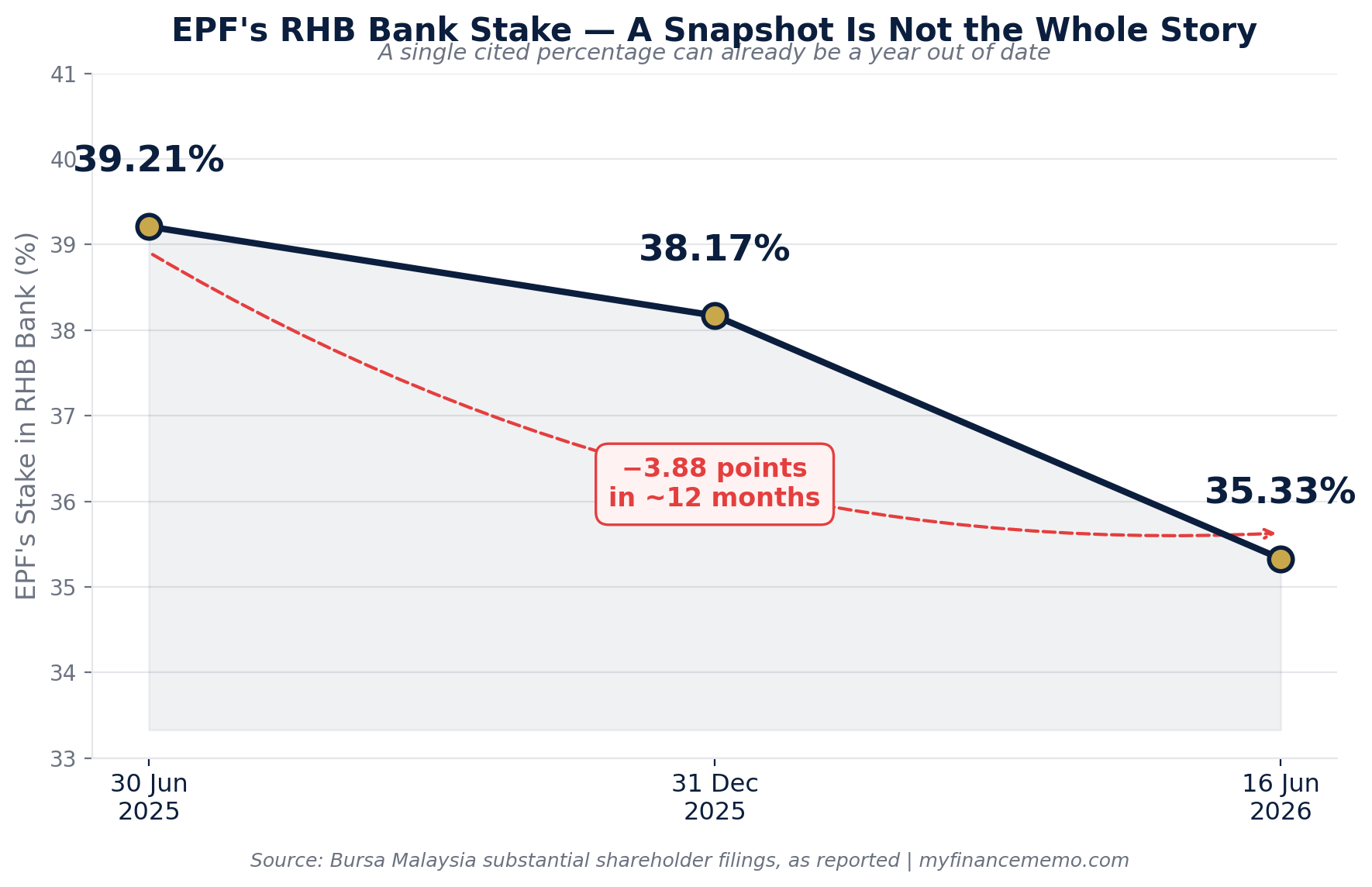
That is a genuine, multi-percentage-point reduction inside about twelve months — on one of the largest positions EPF holds. Anyone citing a specific EPF ownership percentage for any Bursa-listed company should treat it as a snapshot, not a permanent fact, and verify the current figure directly via Bursa Malaysia’s substantial shareholder announcements before relying on it.
The Portfolio Most Malaysians Never See
Here is where it gets genuinely interesting. EPF, like any institutional investor managing over USD100 million in US-listed securities, is required to file a quarterly Form 13F with the US Securities and Exchange Commission, publicly disclosing every US stock it holds. This filing is where EPF’s real growth conviction shows up — and it looks nothing like the Bursa Malaysia portfolio.
For the quarter ended 31 March 2026, reporting on EPF’s 13F filing puts its disclosed US equity holdings at a figure in the range of USD12 billion to USD13.2 billion — sources analysing the same filing arrive at slightly different totals depending on exact conversion rates and reporting date, which is itself a reminder that even “official” numbers vary by methodology. What both analyses agree on: the portfolio spans roughly 70 US-listed stocks, and Nvidia and Microsoft are consistently EPF’s two largest positions, together representing close to a fifth of the entire US portfolio’s value on their own.
⚠ Even the “hard numbers” here disagree: one detailed analysis of the same 13F filing put Microsoft as the single largest position at roughly USD1.21 billion (3.28 million shares) with Nvidia second at roughly USD1.18 billion. A separate widely-circulated analysis of the identical filing period cites different per-dollar sensitivity figures that would suggest Nvidia as the larger position. Both cannot be simultaneously the most precise reading — which is exactly why this article avoids stating a single definitive ranking or dollar figure as unambiguous fact. If you want the authoritative version, EPF’s actual 13F filings are searchable directly on sec.gov.
Beyond the top two, the filing reportedly includes meaningful positions across Meta, Alphabet, Broadcom, Micron, Applied Materials, Synopsys, CrowdStrike, Palo Alto Networks, ServiceNow, Datadog, Eli Lilly, Intuitive Surgical and NextEra Energy — a portfolio that reads less like a passive index tracker and more like a deliberate, thematic bet across AI infrastructure, semiconductors, cybersecurity and healthcare innovation.
But Wait — Is This Actually Reckless?
A concentrated, tech-heavy multi-billion-dollar bet inside a national retirement fund invites real scrutiny, and the criticisms deserve a fair hearing.
“This is reckless concentration for a retirement fund.” A portfolio where two stocks represent close to a fifth of total US holdings is genuinely concentrated by conventional diversification standards. The counter-argument: EPF’s disclosed US 13F holdings, even at the higher $13.2 billion estimate, represent roughly 3% to 4% of EPF’s total ~RM1.44 trillion (~USD325 billion equivalent) asset base. It is aggressive within its own sleeve, but a small fraction of the whole fund.
“EPF should invest more in Malaysia, not less.” Domestic assets generated slightly less than half of 2025’s investment income despite being the majority of the portfolio, while global assets — a minority of the portfolio — generated slightly more than half. Critics argue this exports Malaysian savings to fund American companies instead of domestic infrastructure. EPF’s position is that its fiduciary duty is to maximise risk-adjusted returns for members, wherever those returns are found.
“EPF’s disclosure is misleading by omission.” EPF publishes its Top 30 Bursa Malaysia holdings and produces detailed annual reports and dividend briefings — but its full global equity book is not voluntarily disclosed by EPF itself. The only reason the US tech portfolio is publicly visible at all is because US securities law compels the 13F filing. Without that external legal requirement, most Malaysians would likely have no idea EPF holds meaningful Nvidia and Microsoft positions.
“EPF is too big to trade freely, and that’s its own risk.” When a fund holds a third or more of a company’s shares, its own trading activity can move that stock’s price. The counter-argument is precisely why EPF’s domestic book skews so heavily toward large, liquid, dividend-stable names — a fund this size cannot behave like a nimble trader even if it wanted to.
The Synthesis — Two Funds Under One Roof
Put the two portfolios side by side and the picture becomes clear. The Malaysian book is conservative, dividend-driven and defensive — banks, utilities, telcos, plantations. The US book, visible only because a foreign regulator demands it, is concentrated, growth-oriented and thematically aggressive. Neither is wrong on its own. Diversifying across geography and risk profile is generally sound portfolio construction, and together the two books produced a 6.15% dividend in 2025 — a modest step down from 6.30% in 2024, but still a genuinely competitive result globally.
The uncomfortable part isn’t really what EPF owns. It’s what EPF chooses to actively disclose versus what it discloses only because a foreign law forces it to. That asymmetry is worth sitting with the next time an EPF spokesperson talks about transparency.
Actionable Takeaways
“Transparency is not just compliance. It is trust.”
— Industry commentary on institutional fund disclosure
EPF runs two portfolios with two very different personalities, and most members only ever hear about one of them. That isn’t necessarily a flaw — a defensive domestic anchor paired with an aggressive global growth sleeve is a genuinely reasonable way to build a national retirement fund. But it does mean your annual dividend rate is quietly shaped by decisions — and by companies — you were never told about directly. The next time you check your EPF statement, remember that the number on the page is the output of both a very Malaysian portfolio and a very Silicon Valley one, working together. For more on how EPF’s overall strategy and dividend mechanics work, read our guides on EPF vs ASB as a wealth strategy and 5 Malaysian dividend stocks to hold.
Disclaimer: This article is for informational purposes only and does not constitute financial advice or a recommendation regarding EPF, any company mentioned, or any investment decision. Ownership percentages, portfolio values and holdings cited are drawn from publicly available disclosures and third-party analysis of EPF’s Bursa Malaysia substantial shareholder filings and US SEC Form 13F filings; different sources analysing the same filings sometimes report differing exact figures, and all percentages and values change over time. Always verify current figures directly via Bursa Malaysia announcements or sec.gov before relying on them. Please consult a licensed financial advisor before making investment decisions.
Share this article:
