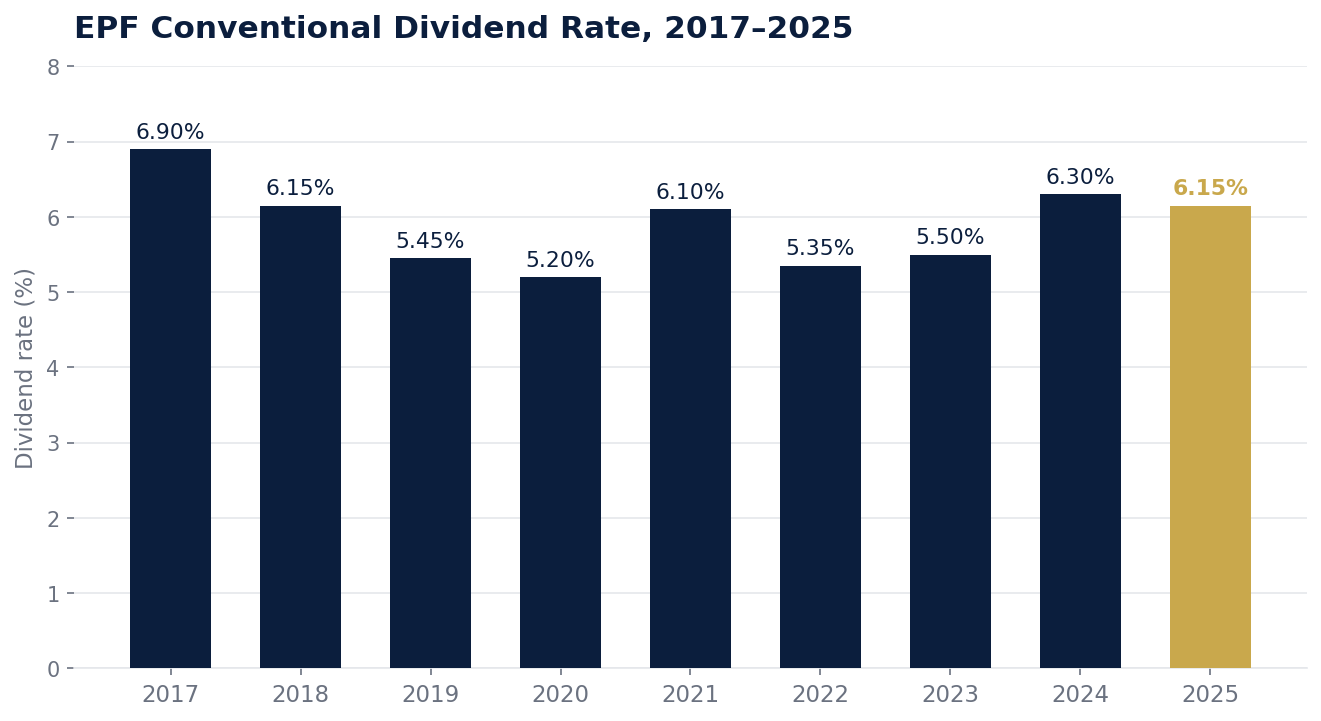
EPF declared 6.15% for both Conventional and Shariah Savings for 2025, down from 6.30% in 2024 — but the total payout hit a record RM79.6 billion (RM67.1bil Conventional, RM12.5bil Shariah), up from RM73.24bil. The rate dipped mainly because Bursa Malaysia’s KLCI grew just 2.3% in 2025 versus 12.9% in 2024, and the ringgit’s 10.2% surge against the US dollar shrank the ringgit value of foreign returns. For the first time, EPF held more in equities (46.1%) than fixed income (44.7%), with private equity delivering the strongest ROI at 10.5%.
Most Malaysians saw the headline “6.15%” on 28 February 2026 and felt a flicker of disappointment — after all, 2024 delivered 6.30%. But EPF also declared its largest-ever dividend payout that same day: RM79.6 billion, close to RM7 billion more than the year before. Both statements are true at once, and the gap between them is the real story. The fund’s RM1.409 trillion in assets is now large enough that a slightly lower percentage still produces a record ringgit sum — while a structural shift inside the portfolio is quietly changing how EPF chases returns for its 18.1 million members.
- 6.15% dividend, down from 6.30% in 2024 — but total distributable income rose 9.5% to RM82.7 billion and total payout hit a record RM79.6 billion
- EPF’s CEO cited two causes: the KLCI’s 2.3% gain (versus 12.9% in 2024) and the ringgit’s 10.2% surge against the US dollar, which shrank the ringgit value of foreign income
- Equities (46.1%) overtook fixed income (44.7%) in EPF’s portfolio for the first time, with private equity’s 10.5% ROI the standout performer
- 6.15% is still above EPF’s 5-year (5.88%) and 10-year (5.88%) average dividend for Conventional Savings
The State of Play
The dividend was announced by EPF chief executive officer Ahmad Zulqarnain Onn on 28 February 2026, and credited to members’ accounts on 1 March. Conventional Savings received RM67.1 billion of the payout, Shariah Savings RM12.5 billion. EPF’s asset base grew 12.8% year-on-year, driven by both investment income and net contributions of RM66.5 billion — itself up 33.8% from 2024, as voluntary contributions climbed to RM19.2 billion.
Why the Rate Dropped — Two Reasons, Not a Crisis
1. Bursa Malaysia Grew, Just Not as Fast
Ahmad Zulqarnain pointed to two principal causes. The first was domestic equity performance: the FBM KLCI gained 2.3% in 2025, closing at 1,680.11 points, compared with a 12.9% rally in 2024. Since equities remained EPF’s single largest income source — contributing RM50.7 billion, or 64% of total investment income — a softer local market directly moderated returns. Equity ROI fell to 7.9% for 2025, though total equity income still rose from RM49.9 billion the year before, simply because the equity book itself is bigger now.
2. A Stronger Ringgit Shrank Foreign Returns on Paper
The second cause is the more counterintuitive one: a stronger ringgit hurts EPF’s dividend. With 38.3% of EPF’s RM1.409 trillion in assets held overseas, currency translation matters enormously. In 2025 the ringgit was one of the best-performing currencies in the world, strengthening 10.2% against the US dollar, 10.1% against the yen, 5.5% against the renminbi and 4% against the Singapore dollar (it weakened slightly, by 2.3%, against the euro). When foreign-currency income is converted back into ringgit, a stronger local currency mechanically reduces the reported value — even if the underlying US-dollar or yen returns were unchanged. EPF has said this currency exposure is a deliberate diversification strategy so that no single year’s exchange-rate swing dominates the dividend outcome.
💡 Worth remembering: currency moves run in cycles. The translation loss from a strong ringgit is a paper effect on this year’s dividend calculation, not a loss on the underlying foreign assets themselves — those assets are still there, still earning, and would boost future dividends if the ringgit weakens again.
Where the Income Actually Came From
The standout line in that table is private equity. Making up only around 8% of the equity portfolio, it delivered the highest ROI of any asset class at 10.5% — comfortably ahead of public equities’ 7.9%. Fixed income, dominated by Malaysian Government Securities, played its usual stabilising role: as bond yields trended lower through the year, EPF’s managers realised capital gains in a measured way while keeping the portfolio positioned for future returns. Real estate and infrastructure delivered a steadier RM1.6 billion — with no repeat of the one-off Q4 2024 property gain that had flattered the previous year’s numbers.
Geographically, EPF’s book is close to evenly split in terms of where the income comes from. Domestic investments — 61.7% of total assets — generated RM39.3 billion, or 49.6% of investment income. Global investments, at 38.3% of assets, generated marginally more: RM39.9 billion, or 50.4% of income. In other words, EPF’s smaller international allocation is punching slightly above its weight, even after absorbing the ringgit’s translation drag.
The Structural Shift — Equities Overtake Fixed Income
For the first time in EPF’s history, equities (46.1%) made up a larger share of the portfolio than fixed income (44.7%). In 2024 the split was reversed — 46% fixed income, 44% equities. It is a small percentage-point shift, but on a RM1.4 trillion fund it represents roughly RM29 billion moving from bonds into stocks and private equity.
EPF’s mandate is to deliver at least 2 percentage points above inflation on a rolling three-year basis, with a hard floor of 2.5%. With bond yields structurally lower than they were a decade ago, fixed income alone increasingly cannot clear that bar — pushing the fund further into equities, and especially private equity, to sustain a competitive dividend as net contributions keep growing (up 33.8% in 2025 alone). It is a deliberate, disclosed shift, not an accident, but it also means members should expect somewhat more volatility in the dividend rate from year to year than in decades past.
But Wait — The Critics Have a Point Too
“The economy grew — why did the dividend fall?” Former finance minister Lim Guan Eng raised exactly this after the announcement, noting Malaysia’s GDP grew 5.2% in 2025 (versus 5.1% in 2024), inflation eased to 1.4% (from 1.8%), and unemployment improved to 3.0% (from 3.3%) — yet the dividend still fell. He linked this to concerns about a “K-shaped economy,” where strong headline growth does not translate evenly across income groups.
The rebuttal: GDP growth and stock market performance are not the same thing. The KLCI’s 2.3% gain reflects corporate earnings and investor sentiment on Bursa Malaysia specifically, and 38.3% of EPF’s book sits overseas, where global market conditions and currency swings matter just as much as the domestic economy. Finance Minister II Amir Hamzah Azizan publicly pushed back on this framing, arguing that critics had “missed the point” by focusing on the percentage rate rather than the record absolute payout.
“12 EPF subsidiaries reported losses — should I be worried?” This figure, from the 2026 Auditor-General’s Report, did circulate and raised questions among contributors. Academics who reviewed the report noted that subsidiary-level losses commonly reflect accounting adjustments — fair-value changes, interest payments back to the parent fund, or early-stage investment phases — rather than cash shortfalls that threaten EPF’s ability to pay dividends. Losses at individual subsidiaries can coexist with healthy returns to the parent fund overall.
“Is 46% in equities too risky for a retirement fund?” A fair question, given EPF’s mandate to protect members’ capital. But context matters: EPF still holds 44.7% in fixed income and a further 9.2% in real estate, infrastructure and money market instruments as ballast. And with bond yields where they are, some additional equity exposure — especially through diversified private equity — may be necessary simply to keep pace with EPF’s own statutory return target over the long run.
How 6.15% Stacks Up Historically
Viewed against a single prior year, 6.15% looks like a step down. Viewed against EPF’s own long-run track record, it holds up well. Conventional Savings has averaged 5.88% over the past five years and 5.88% over the past ten years; the 15-year average is 6.03% and the 20-year average is 5.87%. The 2025 rate sits above both the 5-year and 10-year averages.
It is also worth resisting the temptation to compare EPF’s dividend directly against other national pension funds without context. South Korea’s National Pension Service posted a record 18.82% return for 2025 — but that was driven by an 82% surge in domestic AI and semiconductor stocks, a concentration EPF’s diversified, capital-protected mandate deliberately avoids. Singapore’s CPF Ordinary Account, by contrast, pays a guaranteed 2.5% floor rate with no market exposure at all. EPF sits in a different category from both: market-linked like NPS, but with the explicit statutory duty to protect members’ principal that CPF’s model achieves through a government guarantee instead.
“Our diversified portfolio across asset classes and markets, guided by our Strategic Asset Allocation, has enabled us to navigate market volatility that peaked in the second quarter after the announcement of reciprocal import tariffs by the United States.”
— Tan Sri Mohd Zuki Ali, EPF Chairman
Actionable Takeaways
A 6.15% dividend on a RM1.4 trillion fund is not a step backward — it is what a maturing, more equity-tilted EPF looks like when the local market cools and the ringgit has a strong year at the same time. The rate dipped, the payout didn’t, and the long-run averages still favour staying the course. Curious how that 6.15% actually gets decided, and how contribution timing affects what lands in your own account? See our breakdown of how the EPF dividend rate is set. For the fuller retirement picture, see our guides on EPF vs ASB as a long-term wealth strategy, how much EPF you actually need to retire comfortably, and whether EPF or PRS should come first in your savings order.
Disclaimer: This article is for informational purposes only and does not constitute financial or investment advice. Dividend rates, EPF statistics and figures cited are accurate as of the time of writing (based on EPF’s official 28 February 2026 announcement) and are subject to change — always verify current figures at kwsp.gov.my. Past dividend performance does not guarantee future results. Please consult a licensed financial advisor before making retirement planning decisions.
Share this article:
