Gold has been making headlines in Malaysia recently. Prices hit an all-time high of RM764 per gram in early 2026, a level many Malaysians never thought they would see in their lifetime. Now that prices have pulled back, many people are asking the same question: is now a good time to buy, or will it drop further? The honest answer? Nobody knows. Not the analysts, not the banks, not the financial gurus on TikTok. This guide will not tell you when to buy. It will tell you how to buy smart, where to buy safely, what the platforms don’t advertise loudly, and how to avoid the very real gold investment scams happening in Malaysia right now.
- Gold is one of the best inflation hedges available to Malaysian investors — but it pays no income, so treat it as insurance, not a growth engine
- The price you see is not the cost you pay — every platform has a spread between buy and sell price, and it varies enormously between providers
- Dollar cost averaging is the smartest strategy for beginners — buy consistently regardless of price, and let time do the work
- Always verify your platform on SC Malaysia’s website before investing a single ringgit — gold scams have cost Malaysians billions
Why Gold Makes Sense for Malaysians
Gold has two qualities that make it special. First, it protects against inflation. When the ringgit loses purchasing power over time, gold tends to hold or increase its value. Second, it acts as a safe haven. During economic uncertainty or global crises, investors move their money into gold, which is one reason why prices have been climbing so strongly in recent years.
Over the past 25 years, gold priced in Ringgit has significantly outpaced inflation — we chart the full journey from RM35 to RM764 per gram in our gold price history guide. It will not make you rich overnight, but it will quietly protect the value of your money while everything else gets more expensive.
The One Thing Beginners Always Miss — The Spread
Before we get to which platform to use, understand this first, because it matters more than the platform name on the app.
Every gold platform quotes you two prices — a selling price (what you pay to buy) and a buying price (what they pay you when you sell back). The gap between them is the spread, and it is the provider’s revenue. It is also invisible until you actually try to sell, which is why so many first-time buyers panic when their brand-new gold position immediately shows a paper loss. Nothing has gone wrong — you simply bought at the higher price and are now seeing your holding valued at the lower one.
⚠ This is not a small detail: spreads vary dramatically between platforms — some run close to 5% to 6% round-trip, others closer to 1%. On a RM5,000 position, that difference alone can be several hundred ringgit before gold has moved a single sen. We break down exactly how to calculate this and which platforms are cheapest in our guide on which Malaysian gold account is actually cheapest — read that before you commit serious money anywhere.
Where to Buy Gold in Malaysia
Not all gold platforms are created equal. Stick to platforms regulated by Bank Negara Malaysia and the Securities Commission. Here are the main Shariah-compliant options worth knowing.
Bursa Gold Dinar operates under Bursa Malaysia, the same exchange that runs our stock market, and is widely regarded as one of the lowest-cost options once you understand the spread. MIGA-i, offered by Maybank Islamic, is the most convenient for existing Maybank customers and allows physical redemption — see our guide on how to withdraw physical gold if that matters to you. Muamalat Gold is fully Shariah-compliant with a strong zakat calculation feature. Wahed takes a different approach entirely, treating gold as one component of a broader managed portfolio rather than a standalone account. Pos ArRahnu Gold-i is the newest and most accessible entrant, backed by Pos Malaysia’s nationwide branch network.
💡 MyFinanceMemo Tip: Always verify your gold platform on the Securities Commission Malaysia website at sc.com.my. If it is not listed there, walk away. Gold investment scams are unfortunately very common in Malaysia — Malaysians lost between RM4 billion and RM10 billion to a single scheme, Genneva. Read our full breakdown of how to spot a gold investment scam before you send money anywhere.
Physical Gold or Gold Account?
This is one of the most common questions among new gold investors. Physical gold means you hold the actual gold in the form of bars or coins. You own it completely, but you also need to worry about storage and security. A gold account through a regulated platform means the gold is held on your behalf, backed by physical metal in a vault, and you can buy or sell with a few taps on your phone.
Still not sure which format fits you? Run through the decision below — it takes two questions to get to an answer.
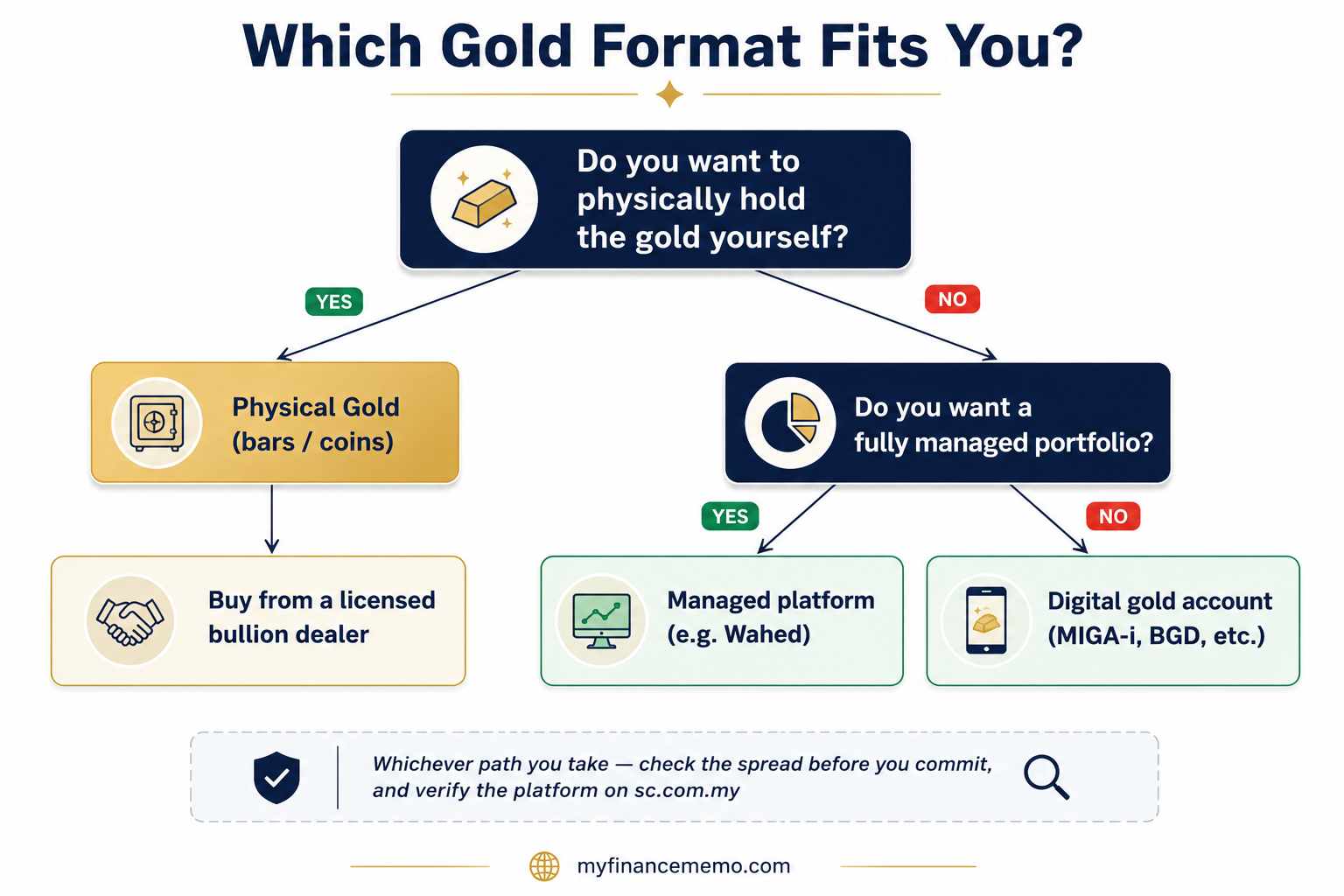
For most beginners, a gold account through a regulated platform is the more practical starting point. Note the PIDM row above — unlike your savings account, gold investment accounts are not protected by PIDM. This is not a reason for alarm given how strongly these institutions are regulated, but it is worth knowing honestly rather than assuming the same protection applies. If you decide physical ownership matters to you, our guide on where to buy physical gold in Malaysia covers dealers, pricing and storage.
When is the Right Time to Buy? DCA Explained
Since gold hit RM764 per gram and has since pulled back, many people feel this could be a good entry point. But nobody can say for certain whether prices will go higher or lower from here. Timing the gold market is nearly impossible, and even professional fund managers get it wrong.
For beginners, the best strategy is Dollar Cost Averaging, or DCA. Instead of trying to time the market perfectly, you invest a fixed amount every month, regardless of whether the price is high or low that month. The effect compounds over time — your average cost per gram ends up lower than if you had tried to guess the perfect entry point and got it wrong. We walk through a full real-numbers example, including exactly how much RM200 a month buys you over a year, in our dedicated guide to dollar cost averaging gold in Malaysia.
💡 MyFinanceMemo Tip: Historically, gold tends to be relatively cheaper when the US dollar is strong, when global interest rates are rising, or when markets are calm with no major geopolitical tension. But with DCA, you do not need to wait for those conditions. You just buy consistently and let time do the work — remembering that the spread discussed above applies to every single purchase, so smaller, more frequent buys on a high-spread platform can add up in fees. Choose your platform with that in mind.
How Much Should You Put in Gold?
Gold should complement your portfolio, not be your entire portfolio. A common guideline from financial planners is to keep between 5% to 15% of your investments in gold. If you invest RM300 a month, putting RM30 to RM50 into gold via DCA is a sensible starting point.
Think of it less as an investment to get rich from, and more as insurance for your portfolio. It protects you when everything else goes wrong. If you are investing specifically because of your faith, our guide on what makes gold investment halal covers the Shariah requirements in full, including zakat obligations on your holdings.
Where to Go Next
This guide covers the fundamentals. Depending on where you are in your gold journey, here is what to read next:
Gold hitting RM764 per gram this year is a reminder of how powerful this asset can be. Whether prices go higher or correct further from here, the fundamentals remain the same. Gold is a proven long-term store of wealth, an inflation hedge, and a safe haven in uncertain times — but the spread you pay to get in and out matters just as much as the headline price. Start small, be consistent, use regulated platforms, check the spread before you commit serious money, and never invest in any gold scheme you cannot verify on sc.com.my. The opportunity is real. The scams are real too. Stay smart.
Disclaimer: This article is for informational and educational purposes only and does not constitute financial advice. Gold prices, spreads, fees and platform terms change frequently — verify current details directly with each provider before investing. Please consult a licensed financial advisor before making any investment decisions. Past performance is not indicative of future results.
Share this article:
